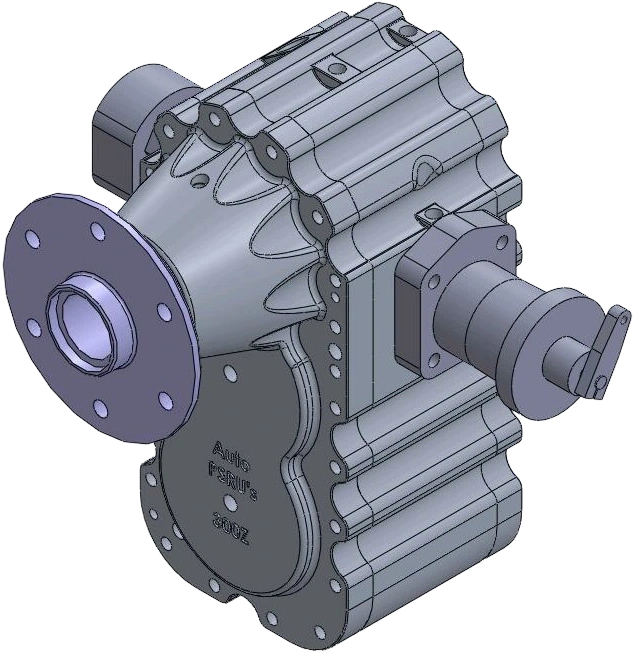
We provide top quality reliable gearboxes called Propeller Speed Reduction Unit’s (PSRU’s) to convert automobile engines for use in Experimental Homebuilt aircraft.
Our Firewall Forward Packages provide builders with an affordable alternative to expensive certified engines that are more reliable, burns less fuel, and are cheaper to maintain. We have converted Subaru 4 and 6 cylinder engines, Mazda 13B Rotary engines, and all of the Chevrolet series of LS engines. If you want to use a different engine call us. Our PSRU’s can be adapted to just about anything between 150 HP to 550 HP.
The new 300Z is designed for use with inline 4 and 6 cylinder engines as well as V6 and smaller V8 engines.
Located at the Hillsboro, Texas airport (KINJ) we demand perfection while producing a solid, dependable product.

Stuart’s experience with aircraft design and building Experimental aircraft started in 1976. His experience in the aerospace/defense industries as an engineer started in 1979 after graduating with a double major in Automotive and in Aerospace technologies. He has been a member of EAA since 1981. Stuart is qualified on both sides of engineering and building components for aircraft and automobiles. Born in Fort Leonard Wood, MO in 1956 and then growing up in Gladstone MO Stuart started his mechanic skills with lawnmower engines then moved up to automotive maintenance in high school. A love for everything in aircraft and aerospace started much earlier with building static models and then fly-by-wire models. While in college Stuart earned his private pilot’s license and graduated in 1979.
After graduating, Stuart’s career led him to working on aircraft, missile systems, electro-optic weapon systems, satellite systems, and space shuttle components. In addition to working on his career full time, Stuart continued to pursue his hobbies which included working on hot rods, swapping V8 engines into Chevy Vegas, MGB GT’s, and boats. As an active member in various EAA Chapters he also helped friends complete their homebuilt aircraft. While living in Orlando FL he was also a part-time volunteer at Tom Riley Aviation in Kissimmee FL helping to restore various warbird projects. Currently, Stuart has a Wheeler Express under construction and plans to install the BW350 and LS engine combination in it too. Look for it at future aviation events.
One of Stuart’s major interests in experimental aircraft has always been the use of alternative engines. He has followed the development of both automotive engines, modifications, and PSRU designs for over 35 years. In his opinion, Bud Warren’s design is the most successful design fixing all the major problems that have plagued other designs by solving them with creative yet simple features, plus holding the promise of a long service life as well. It is Stuart’s plan to take Bud’s design and features to the next level with a series of refinements and improvements while continuing to support previous customers of Geared Drives. Stuart shares many of Bud’s philosophies/beliefs and plans to provide the same high level of quality parts, services, and support to all of his customers.
In 2012 Auto PSRU’s took the time needed to get everything transferred from Conroe TX to our first location, then our current location, set up, staffed, and pick up where the previous company left off in 2010. A lot has been accomplished since 2012, and we look forward to more future growth and developments. Auto PSRU’s has exhibits at Sun ‘n Fun and at AirVenture every year. You can meet Stuart there, or if you are in the Dallas/Fort Worth area drop by our hangar on the Hillsboro Airport (KINJ).
With fifty years of experience with building and troubleshooting engines and equipment, and qualifications including his A & P license, Bud Warren was a highly qualified builder of aircraft components. Born in Springfield, MO in 1940, Bud always loved things that go fast-and worked on fast cars even as a child and up through his teenage years. As a young man he knew he needed to get to a place where he could learn more and have more opportunity-so in 1958 he moved to Houston Texas. Bud worked in the oilfield and aerospace industry in problem solving for a NASA subcontractor for Boeing Aircraft. Bud was instrumental in the development and perfecting of control instrumentation, and even built the valves that charged the fuel rockets for the Gemini Space Program. Bud was a master machinist and knowledgeable metallurgist having operated his own job machine shop for almost thirty years. During this time, Bud received his certification as an aircraft welder.
Since the later 1950’s, Bud was on the cutting edge of the drag racing industry developing new ways to go fast and in a more safe race car. His passion led him to obtain his SEMA licensed as a builder and inspector of top fuel, funny car, and other classes of NHRA, IHRA and AHRA drag cars. Safety had always been his concern. Bud was also a very accomplished and well known driver, and held his top fuel and funny car license for twenty years. He also engineered and built top fuel and top alcohol racing engines for drag strip, drag boats, and circle track cars.
How to apply the power to the wheels and get to the finish before the other guy was the whole point in auto racing. Minute little changes in set up could mean the difference between making the round without blowing the engine, or the difference between winning or losing. Bud had an intimate understanding of engines, clutches and transferring torque into forward motion. In 1980, Bud purchased his first airplane, a Mooney, so that he could attend more drag races! This started his love of aviation.
Bud was a devoted Colonel of the Confederate Air Force (now the Commemorative Air Force) and member of the Tora Tora Tora Squadron. There were no aircraft for him to take over and sponsor at the time, so he decided he would add one to the organization by finding a project and building one. After some time he found a BT-13 stuck in a muddy field in Galveston County, Texas, made the deal on the airplane and set out to try to get it home. After several days of working on it, he literally flew this old BT-13 out of the muddy field where it had sat stuck in the mud for years. He then totally rebuilt into a replica of a Val that is still flying today. This airplane is now a representative of the Commemorative Air Force and still shows Mr. Warren’s name as master craftsman. With all of his hands-on experience one can see the position of knowledge and credibility which has been the basis for all his PSRU and engine designs.
In 1992, a friend approached Bud about the possibility of using a small block Chevrolet in his homebuilt Wheeler Express. Bud was fascinated, saw a challenge, and set about to design and put together an engine and drive combination that would be safe and dependable. As a licensed A&P Mechanic, he was intrigued with the idea that an automobile engine could be successfully installed and used in experimental aircraft. The weak link in this assembly proved to be the propeller speed reduction unit. After months spent researching the PSRU’s that were on the market and available at the time, decided there must be a better way. With his experience with automotive engines and transmissions, he set out to design a redrive that would engineer out the typical problems that arise with the use of an automobile engine in an airplane. After years of research and development, trouble shooting, and many hours of test flying, Bud succeeded in engineering out all of the inherent problems associated with such an application.
Bud purchased the Wheeler that he started helping his friend build in 1992 prior to it’s maiden flight, and was powered by the same Chevrolet engine and prototype PSRU that Bud designed and built for it for over 700 hours. He often took his friends and family for sight seeing trips and cross country travel in this aircraft. Bud was passionate about his convictions and his mechanical knowledge of the experimental aircraft industry, and firmly believed in this redrive and engine combination as evidenced in the fact that he flew it himself.
The following is a synopsis of Auto PSRU’s philosophy based on Bud Warren’s personal opinions, first published in Geared Drives website, about the auto engine conversion industry, and some of the concepts that are in use regarding automotive conversion technologies. Many of these opinions are shared by me and will continue to be the basis of Auto PSRU’s future. The updates below include some changes while respecting Bud’s work. As you read about this philosophy, please remember that it is not intended to offend anyone. This philosophy is based on Bud’s many years of personal experience with auto engines, experiences with certified engines in aircraft as an A & P, his knowledge and experience as a job machine shop owner and operator for thirty years which has given him a unique perspective based on actual knowledge, and my own experiences as an engineer. Bud as well as I feel that this perspective is based on real experience, as well as sound engineering design. This may represent what you might consider to be some rather strong opinions regarding some issues and designs that you might disagree with. Auto PSRU’s does not wish to alienate anyone or make any enemies. It is very important to us that you know that we do not advocate what we know is dangerous, based on personal experiences and sound engineering. Doing so goes against our values and concern for our fellow man. So, be advised that the following will speak honestly and without reserve regarding this philosophy.
Race car engines are not the best for aircraft use so don’t make the mistake of building a race car engine for your airplane. Use a mild engine at a conservative power setting. For instance, a stock Chevrolet LS1 crate engine has a nice flat torque curve in relationship to HP. Ideal auto conversion engines will have a low lift and low duration cam in combination with heads that have very small air chambers. This combination allows for a stronger power stroke and increased torque, much like one would want for use in a truck or a tractor. For example, the torque curve of this engine shows maximum torque between 3000 and 4000 RPM. Now, add a prop reduction drive utilizing straight cut spur gears with a mild reduction ratio of 1.562:1.00 and the result is a conservatively built engine, operating at a conservative engine RPM, using less fuel, creating less engine heat, and at the same time amplifying torque to the prop. Performance being one of the goals, our automotive conversion aircraft will fly circles around the same airplane with a certified aircraft engine, due to amplification of torque to the propeller through our Auto PSRU gearboxes. For instance, 350 ft lb of torque to the crankshaft at takeoff results in 546 ft lb of torque to propeller. With a constant speed prop and the Auto PSRU gearboxes, you will not believe the climb rates that you will have at your disposal. Believe me, when you need it one day, you will be glad you have it.
Click on the links below to view the graphs. Once you open the graph, move your mouse to the lower right of the image and click on the small box with four arrows on it to expand each graph to full size for easier viewing. Click your browser’s back button to return to the previous page.
LS3 Horsepower vs. Torque at crankshaft
Engine to Prop RPMs with HP and TQ at Propeller Reduction Ratio 1-2/3 : 1
Automotive engine technology is the best it has ever been, however, as an A & P, Bud had seen the inner workings of certified engines on a consistent basis. Stuart has also seen the engineering developments that went into the latest generation of automotive engines. It seems that the FAA has made it so costly and difficult to have any new advancements for certified engines approved for use that the industry has found it more realistic to just stick to the status quo when it comes to engines.
After all, new aircraft are still being sold, and there is no real reason to change anything up in the area of the engine technology. Advances such as a spiffy new paint scheme, leather interior and a new flat panel instrument set are about all it takes to make a sale. Certified aircraft engines utilize virtually the same technology that they have used for the last fifty years or more.
Today’s automotive engines have technological advances that in many cases render them virtually ideal for use in our experimental aircraft, due to their compact size, fuel injection systems that automatically adjust for altitude and a variety of horsepower ranges available.
With the advancement of superior aluminum casting techniques within the automotive industry and the availability of even lighter complete engine packages, auto engines can now compete with, and in many cases are even lighter weight than the certified engines that they would replace, offering a superior horsepower to weight ratio.
We have observed that a lot of resistance to auto engines in aircraft is a direct result of the lack of a dependable way to convert horsepower and torque to the propeller. Belt and chain drives have achieved marginal success, but marginal success is not what we are willing to settle for. No offense to anyone, because we could have developed a belt or chain drive as well, but the plan was to set out to build a better mousetrap.
From our perspective, the inherent danger with a belt drive is the belt itself. Anyone that has been to the drag races or watched Speed TV has seen the sudden loss of power due to a belt catapulting off into the atmosphere.
This might be an accepted risk in a race car since you have a chance to come back next round and start over, but in aircraft there might not be another opportunity. We are not willing to stake our life or anyone else’s on any belt of any kind.
Bud had personal experience with chain drives as well, and said he did not like the idea that chains are only as strong as their weakest link. Chains fail too, and there are too many horror stories regarding slack in the chain of a PSRU, whose builder had dismissed as “normal”.
These chains can crawl off the sprockets at an inopportune time, leaving the pilot with no choice but to put the aircraft down wherever he happens to be and pray for the best. We are not resistant to taking a calculated risk, as there is always risk, but this kind of risk is not acceptable to us when there are more safe and dependable options that we have the experience and knowledge to develop.
Being a former drag racer for many years, Bud had hands-on experience with planetary gears which do well in situations that require high RPM for a very brief period, but are not designed to operate under consistent and continuous use. They were designed to simply transition from one gear to another.
This ultra high RPM due to the gears being so small is not conducive to long life of a PSRU. We are strongly opposed to using planetary gears in something as vital to safety as a PSRU, especially when the straight cut spur gear is the superior option and has been incorporated into a superior redrive, such as in the Auto PSRU designs.
Bud’s challenge was to engineer a PSRU that would allow an aviator to use an auto engine in an airplane in exactly the same way that it was designed to be used in a car. Therefore, This design transfers power to the prop from a series of spur gears driven off the crankshaft on the transmission end of the engine, and through an input shaft just like an automotive transmission.
In doing this, there are no side or thrust loads on the crankshaft from the propeller, so you can expect long engine life, dependability, and similar service as you would obtain from your family car. In addition, by reducing RPM’s from the engine to the prop through sturdy spur gears, torque is multiplied to the prop. Actually, all of the Auto PSRU gearboxes are more accurately described as a single speed transmission in its design and function.
Another important consideration of the design of Bud’s PSRU is that it must maintain the propeller thrust line while allowing the engine to be placed in a lower position within the cowl.
Driving the prop directly off the crankshaft of an auto engine, is simply a major failure waiting to happen. Some builders are doing it and appear to be doing it successfully, but there are too many differences between automotive engines and aircraft engines to advocate a direct drive from an automotive crankshaft.
You can do just about anything for some period of time before suffering a catastrophic failure. Direct drive off an auto crankshaft is not wise because crank bearings on auto engines are narrow and comparatively offer perhaps 20% the bearing surface for support of the crankshaft than that of a certified aircraft engine. Auto engines were not designed to take the side and thrust loads that the propeller will apply to the engine if directly driven off the crank. With this in mind , a PSRU was developed that would allow the engine to drive the prop the same way it would drive a transmission.
Our PSRU’s do not apply any loads to the engine that it was not designed to accommodate. Therefore the result is longer engine life with a higher safety factor and greater dependability.
The Auto PSRU designs incorporate a rather ingenious custom design for any automatic centrifugal clutch and flywheel. The centrifugal clutch assembly keeps the starter from pulling the inertia of the prop just long enough for the engine to start, which will contribute to longer starter life. The clutch also acts as a damper, eliminating harmful harmonic vibrations and offers smooth operation.
Once the engine is started, the prop will begin to spin due to inertia. At around 800-900 engine RPM, the counter weights engage, capturing the clutch disc between the flywheel and pressure place, fully engaging the propeller.
The harder the engine runs, the harder the clutch is engaged, therefore, the more firmly the prop is engaged. The prop will remain engaged as long as the engine is spinning. As a result, when the engine is turned off, the propeller spins down to a stop-similar to a turbine engine aircraft. This prevents the propeller from forcing the engine through its high compression strokes until it stops, also known as “prop kick-back”, eliminating the resulting vibration loads from going into the aircraft frame and delicate systems.
Bud started developing his gearbox in the early 1990’s. He had many exciting victories, and moments of pure let down when he realized that the theory did not result in success. The result was the PSRU being redesigned multiple times, each time resulting in a better unit with fewer issues. It had to be smaller, lighter, stronger, more dependable, and simplify the installation of an automotive engine within the cowling. After years of development Bud was happy with the performance and longevity. We are pleased to offer it to other aviators.
Bud said that all of the experiences in his life have lead to the development of this PSRU. Without these experiences, the development of this unit would not have been possible. It is the mission of Auto PSRU’s to continue with the development and improvements to keep them the best available to our customers.
Gears require different lubricant than does the engine. Basic engineering standards were developed for the proper lubrication of a set of gears to assure a long service life. Separate lubrication systems are required for safety and for proper engine and gear function. Sharing engine oil with the PSRU is asking for engine and/or PSRU failure in advance.
The Auto PSRU design has its own reservoir, forced and filtered lubrication by means of a dedicated oil pump, and utilizes the proper weight and type of gear lubricant that ensures long life of the unit. Bud felt that synthetic lubricants certainly sound great, but they do not perform well in a gear box.
Bud tested multiple synthetic lubricants and each failed to provide adequate cooling and eliminate noise. Bud recommended the use of all mineral 85-140 Gear Lube, of a type containing anti foaming properties, which is indicated for fill up, not just top off.
For now the use of any lubricant other than what is recommended could void the Auto PSRU’s warranty. The results of additional testing of synthetic lubricants, and improvements in the lubrication system, will be announced if they are found to be an improvement.
Bud said that he developed his PSRU from the sweat of his brow and from his own personal earnings. Though he said he had many offers, he resisted taking on any investors or partners. “I have a huge personal commitment to this project” said Bud, just as each and every kit or scratch builder has. Bud flew his PSRU in his test aircraft for nearly 400 hours before he was prepared to offer it to other aircraft owners at Oshkosh in 2006. “We flew our Geared Drives PSRU on a 383 Chevrolet engine in our Wheeler Express with great success” Bud commented, “I do not know of any other PSRU builder that has actually owned and flown his own invention in an aircraft for any period of time. Until we lost our Wheeler in October 2008 due to a failed fuel line and resulting fire, we had flown just under 700 hours in approximately three years, including trips to Oshkosh and Sun N Fun.”
Bud had a lot of empathy for those that he had met that expressed to him that they had been taken to the cleaners by someone who came before. Bud said “I feel strongly that no designer or builder should finance the research and development of his design concept from the funds of fellow aircraft owners. ” Many of us have met some of the victims of this kind of activity and found it deplorable. Doing business like that creates bad will in the aviation community and the end result is just downright dishonest.
If you are going to do business this way, just go ahead and collect money from folks and call them investors, not customers, so at least they will know that there is a chance that they will lose their money in advance, and that they never receive the product that they have ordered and paid for. At least that would be honest.
Bud said “My opinion is that nothing should be offered for sale until it is tried and true and the designer can ship it out with confidence that the customer will enjoy a good flying experience with the product.” We all acknowledge that experimental aviation is a risky endeavor. We constantly strive to implement new changes and modifications to make our units even more dependable.
Safety being our first consideration, we do not advocate the use of belts, chains or planetary gears in something as important as a propeller drive. Our experienced opinion is that belts break, chains stretch, and planetary gears are simply not designed to operate at high RPM and under such a great and constant load as they are under while in use in an airplane.
Straight cut spur gears, as those used in our PSRU on the other hand, are designed to safely operate at a high RPM and under continuous use. Noisy? No. Many will argue with that statement. Using fine quality gears (these are not farm tractor gears) setting the unit up with the correct lash and clearances, and keeping the gears cool and well lubricated is the key.
We chose to use what we know to be the best technology for this application because our objective was to do what makes sense in terms of safety, reliability, and ease of maintenance.
Thank you for taking the time to read about these opinions.
Stuart Davis
Bud’s opinions above have been modified by Stuart Davis to reflect the current situation and the transition to Auto PSRU’s. The dedication to improvement through testing, safety, high quality, and support to all customers will continue.
There are forty four customers out there now, most completed and flying. We are always excited to share their successes with you and hope that you enjoy their comments and share in their excitement! Keep letting us know how you are doing out there and we will continue to post your news here!
Frank Braun announced his first flight in his Bearhawk with Geared Drives LS1 engine package, and reports happily that the engine runs cool – in the 160’s, and that the gearbox was too cool to get out of the “yellow” of his engine monitoring system. We explained that the gearbox will almost always hold temps that are cooler than the engine, and that is a good thing. Frank took Geared Drives advice and custom tailored his cowl for the best engine cooling. Take a look at the great job that he and his buddy Donald did in the photo below:
Frank interpreted our cooling recommendations to the letter and has achieved the cooling that this system was designed for. Note the front inlets are blocked off, the side scoops and large volume of exit air in the belly. Congratulations to the Braun’s for what we believe will prove to be one of the best performing Bearhawk aircraft around!
To see more information on Frank’s airplane, log on to Facebook and search for “Bearhawk Airplane”. Check the photo section for more. You can also see Franks first takeoff on Youtube here.
Oshkosh flight report from Bill and Lynell:
“Here we are at AirVenture 2010 with our Geared Drives LS1 powered RV10. Lynell and I flew up from Conroe, Texas with a overnight stop at Iowa City, Iowa. Lucky for us we arrived at Oshkosh as planned on Friday afternoon before the show to find a nearly empty pattern, a dry parking spot, and plenty of EAA volunteer help to get to our dry campsite. There was great interest in the RV10 FWF package all week as a steady stream of aviation enthusiasts as evidenced by the flattened grass around the front of the airplane. This was our first long cross country trip in our 10 and the Geared Drives LS1 ran great. We averaged 160 kts burning 12.5 gph for the trip adding 15 hrs to the Hobbs meter which now has rolled over to 120 hrs.” Bill and Lynell Gipson, Conroe, TX
“I feel like I can get in my airplane anytime I want and fly anywhere I want.”
“…we just recently returned from our “Spring Break” vacation flying our RV10 down to Kissimmee, FL. for Astros spring training baseball, then north to Nashville to visit my daughter and family, and return to Conroe over a span of 11 days. We had a great time and the Geared Drives LS1 ran flawlessly.
The recent changes made to the cooling system replacing the existing singe radiator, two fans, and a cowl flap with two side mount radiators with fresh air scoops (no fans or cowl flap) worked like a champ. This trip was the first real test of the new cooling configuration and I’m happy to report that the water temps NEVER got above 198F in climb and stayed at a constant 192F during cruise and while taxiing. A thermostat is currently installed in the system and I’m thinking of removing it for the upcoming summer season. The old configuration based on my earlier experiences would have provided water temps in the 225-230F range. I’m much more comfortable with the new configuration as it gives me a temperature cushion which allows me to push the engine especially in climb without fear of overheating. Thanks to Bud for developing the necessary changes and providing his expertise to make this happen.
One other change made was to provide cooling air to the gearbox by drilling 3 small holes in the cowling. My gearbox temps before this modification reached 205-210F due to the hotter engine temps and the lack of air passing by the gearbox itself. During this trip the gearbox temps were running 165F in cruise and slightly higher in climb, but NEVER got above 185F.
Bottom line: The modifications we made to the RV10 LS1 cooling system and cowling have now proven successful and will undoubtedly result in better performance and longer engine life going forward.”
Bill Gipson
N730WL
Geared Drives LS1 powered RV10 (175 hrs 3.24.2011)
“…Yes 5k on the core engine…pulling 2550 on the T.O. I did my second flight this afternoon after balancing the prop. Much better in the vib department. Super smooth. I had a 24 kt headwind on takeoff and she leaped off the runway…I was chasing the IAS trying to hol 110 kts for the climb but over 1600 VSI to 3000 MSL. This prop and gearbox IS WAY faster than my MT…here are the #’s from today’s flight:
Level at 3K with full throttle : |MAP 25.5 Prop 2117
Core engine 4500 RPM FF 13 gph
IAS 159 kts TAS 170 kts”
Big Grin ;^O
Lee
What temperature does the PSRU operate?
How is the PSRU lubricated?
All of our gear boxes run cool with proper air flow over the gear box. High temp for our unit is 200 degrees F. We test run each unit for an hour each before delivery, and the highest temperature we have seen is 170 degrees F on our test stand. You can expect to see higher temperatures during climb out, but once you have leveled off the temps will normalize again. The maximum temperature should always stay below 220 degrees F.
This unit has a separate oil reservoir with its own oil pump and filtration system, lubricating all of the gears, bearings, shafts, prop hub and prop governor with clean, filtered oil as long as the prop is turning.
We have tried virtually every kind of oil and gear lube on the market, including five or more major brands of synthetic gear lube. The recommended gear lube is Amsoil synthetic Severe Gear 75W-110 gear lubricant. Heavier rated weight gear lubricants can be used, but not lighter rated ones. A regular mineral type of 80W-120 or heavier gear lube can also be used. This will be labeled “limited slip, API service GL-5” or greater. It will generally be formulated with more or less enough anti-foaming additive to keep the gear lube from foaming up, but brands and even batches will vary. Because of this, gear lube should be checked during ground testing when the PSRU is first installed and checked to be sure it does not look grayish or cloudy in color, which means it is foaming up. Foaming means that there is too much air in the oil and that will not allow the lubricant to film properly on the interior parts and will cause premature wear of the internal components. If this happens contact us as soon as possible for how to correct this issue. Under no circumstances fly with a foaming problem.
Never use full synthetic engine oils in any engine. Semi-synthetic oil works great in auto engines if you are ever use 100LL for fuel. Full synthetic oil will fail miserably in an engine as they typically don’t have the correct additives to process the byproducts of lead created after the combustion cycle.
Return to top
The SD400 and SD550 gearboxes holds three quarts of gear lube. The 250Z and 300Z gearboxes holds two quart of gear lube. If you choose to use an oil cooler, simply add the capacity of the oil cooler and oil lines to the fill up volume. All of our gearboxes come with a sight tube on the front that clearly mark the “Full” and “Low” level of lubricant prior to running. It may take up to 15 minutes after running the gearbox for all of the lubricant to settle out and get an accurate level of lubricant reading in the sight tube.
One customer is using a King Air type prop, and this prop and hub demands so much oil volume that the only way to supply enough lubrication to the gearbox, propeller, and governor was to add a reserve oil tank for the gearbox to draw from and for the oil to return back to when the engine is off. This kind of propeller will draw enough of the oil out of the gearbox that it will fail due to insufficient lubrication. If you are planning to use a propeller like this feel free to contact us for more information.
Return to top
All of our gearboxes pump fresh filtered lubrication throughout the entire system supplying oil to the prop governor and propeller. The drive port for the governor is located on the side of the gearbox and driven from an accessory shaft that turns off of splines on the prop shaft. The other end of the accessory shaft powers the oil pump for the gearbox.
Return to top
If your prop turns the conventional direction and your prop governor turns clockwise, it will work with our PSRU with no modifications. We have not found any particular brand of prop governor that does not work with our system. Even though we are supplying oil at 60 PSI to the prop governor, we have found that a prop governor does not require a massive quantity of oil if the governor and propeller are in good repair and are not leaking. The prop governor itself is an oil pump, so as long as it has a constant steady oil supply it will function properly. We have tested this theory by cutting down the oil flow with a 1/8″ orifice and the prop governor still worked correctly. We do not have any oil temperature, oil volume, or propeller governor problems.
Return to top
The centrifugal clutch serves a number of different functions, but the primary and most important is that it serves to resolves torsional vibration by means of a set of heavy polymer coated springs in the center of the clutch disc. Since the clutch disc, flywheel and pressure plate do not constitute a hard connection, there is thought that perhaps some of the harmonic issues might be solved there as well. In addition, the centrifugal clutch engages the prop at low RPM and after the engine is already running, which dramatically extends the life of your starter. The clutch also disengages when the engine is shut down eliminating propeller “kick-back” from shaking the entire aircraft. Clutches have been used in auto engines to dampen harmonics between the engine and transmission for many years. Without a clutch in your transmission to serve this purpose, your vehicle would hop and skip down the road instead of rolling smoothly to your destination.
Return to top
No it does not. We tested our PSRU for literally hundreds of hours on the ground and experienced no chattering or vibrations at any RPM. Bud flew his Wheeler for nearly 700 hours with great success and no torsional vibration. Our gearboxes operate smoothly at every RPM and transitions equally as smoothly from high to low RPM and everything in the middle. The only issue we have seen was when a customer wanted to set the idle on his engine at only 500 RPMs, which was only 300 RPMs for the propeller. This is too slow for any engine. The recommended minimum idle is 800 to 900 RPMs. The propeller will not generate enough thrust to start taxiing until about 1200 to 1400 RPMs, which is 2000 to 2300 engine RPMs.
Return to top
Years of designing, redesigning, going back to the drawing board and starting over have yielded gearboxes that utilize a custom designed centrifugal clutch assembly. This was designed specifically for use on an automotive engine for experimental aircraft, and incorporates a clutch with the correctly sprung center clutch disc and friction material for the engine application. This use of this disc not only makes the system work and eliminates torsional vibration, keeps the gearbox disengaged from the engine long enough get it started which avoids strain on the starter. There is virtually no wear on the clutch disc since it simply engages and then disengages. The harder the engine is running, the more firm the connection between the clutch and flywheel.
Return to top
I choose to use the best for safety and dependability in our gearboxes. For this reason, I am against the use of planetary gears in any gearbox. Considering what they were designed for, to change an automatic transmission from one gear and into another. They were designed to work at high RPM for only short periods of service. They are very small and turn at ultra high RPM when in continuous use, and from twenty plus years of personal experience in professional auto racing, Bud’s personal opinion was that there is no way that planetary gears can possibly hold up long term. The strongest and most dependable kind of gear is a straight cut spur, which is what was chosen to use in all of our gearboxes.
Return to top
Yes. We have an early model Chevrolet LS engine that we use to test run each gearbox. For break in, we bolt on a test propeller and test run for one hour following the resolution of any leaks that might be found. This allows the seals to seat and the operating temperatures to normalize. We run the unit from 500 RPM all the way up to takeoff RPM of 3900-4500, and everything in between. We are able to cycle the prop, make many engine RPM changes, and put the engine and gearbox through the same paces that you would if you were ground testing it on your aircraft. This way, we can ship these units out knowing that all is exactly as it should be. To witness this test run is an incredible sight. The smoothness and ease of operation is really rather incredible. We can also video a test run of your gearbox or Firewall Forward package and send it to you.
Return to top
The original BW350 had great success with 405 HP in the 383 Chevrolet installed in his Wheeler Express for the nearly 700 hours that he flew as a test aircraft, so we can say for a fact we know that it will hold 400 HP. When upgrading several features on the BW350 it was renamed the SD400 for the 400-500 HP rating. The SD 550 is rated for 550-600 HP. The smallest gearbox, the 250Z, is rated for 300 HP. The intermediate 300Z gearbox is rated for 400 HP as well.
Return to top
Yes. When you place your order one of the things we require is that you indicate your propeller type and bolt pattern so we can drill the propeller shaft bolt pattern correctly. We provide a plug at no cost to you for the prop shaft to close off the hydraulic system if you are going to use your electric propeller. We can also assist with mounting the electrical brushes to the gearbox.
Return to top
We have long stated that we have no restrictions on which propeller you can use with our selected gearbox and to the largest extent that is true, however be aware of the following:
1) Fixed pitch props lack the protection of a propeller governor which means there is no provision to keep the prop from “over speeding”.
2) King Air props. These props require an inordinate volume of oil and literally suck the gearbox dry of oil. If you must use one, contact us about how to construct and plumb in an auxiliary oil tank for the gearbox to draw from and to provide a place for the oil to drain back into when the engine is shut down.
Return to top
Any plans for a PSRU for Mazda?
Yes. Our 200Z Zero Offset PSRU fits Mazda, Subaru, Corvair, VW, etc and adapts by means of a mounting plate specific to the engine. We already have several customers flying with the 200Z and have reported exceptional performance, commenting on how smooth and powerful their engines now run. They also reported cooler engine temperatures, improved climb rates and more economical fuel burn. It appears that we have built a gearbox that the Eggenfellner owners would not only be pleased to fly, but will improve their engine and aircraft performance far beyond their expectations. The current version of the 200Z is the 250Z with several upgrades.
Return to top
Why build a FWF package for the RV-10?
How much does an LS3 engine package weigh vs. an IO-540?
The RV-10 is a perfect airframe for an engine such as the LS3. The LS3 and the Auto PSRU’s engine package is ideal for pretty much any application that would normally have called for an IO-540 or O-540. This engine package, ready to run with all accessories including radiator, starter, alternator, oil and water, comes in about 10 pounds less that the average IO-540. So the old myths that auto engines are so heavy is not entirely accurate when you consider the modern all aluminum auto engines of today. We have developed a firewall forward package for the RV-10 that would allow the owner to basically bolt the it on, wire it up, hang the prop, and go fly within a few days.
Return to top
The ready to fly weight of the LS1 (less prop), complete with PSRU, flywheel, engine, radiator, all accessories, including alternator and starter, water and oil, comes in just under 500#. Bud removed an IO-540 from a Glasair III and weighed it on certified aircraft scales it came in at 530# (less prop). Yes, the LS1, ready to fly, less prop, apples to apples, weighs in less than an IO-540 and has a lot more horsepower and torque.
Return to top
The LS3 will happily operate at higher RPM than the IO-540. What makes the difference is that the IO-540 as a reciprocating engine which has a long stroke and monstrously large, heavy pistons. The LS3 runs at a higher RPM than does the IO-540, but the rods and pistons are so very much smaller and lighter than the certified engine pistons. Put this into perspective, only one piston from out of a I0-540 weighs nearly what an entire set of LS3 pistons weighs. The lighter pistons of the LS3 in this smooth running and well balanced engine are not creating a lot of wear and tear in the engine. The LS3 engine is capable of running happily at a higher RPM with no problems at all. Chevrolet has tested these engines unmercifully and they have proven their durability again and again.
The engine RPM range that we advocate using for aircraft use is really quite mild for the LS3. We like to see takeoff RPM’s around 3900-4000, not because more is hard on the engine, but because this is all you need for awesome performance and fantastic climb rates when combined with the Auto PSRU’s gearbox and a constant speed prop. You can even go up as high as 4300-4500 RPM if you have a heavy load, and it will not hurt the engine. With the Auto PSRU’s gearbox and property set prop governor, you will not over speed the prop and you will have lots of excess power at your disposal. You will however, need to be judicious in how you apply that power. These engines have so much power and torque that it would be easy to torque-roll the airplane if you apply it all at once. For a safe take-off the throttle must be advanced slowly until there is enough airspeed to generate full rudder authority. Otherwise putting in full power from a dead stop will have the aircraft making a right turn off of the runway.
Return to top
We think that the P-51 is an excellent platform for a Chevy LS V8 and the Auto PSRU’s SD400 or SD550. Bud met half a dozen or so fellows at OSHKOSH in 2009 with P-51 replicas and was anxious to get one in the air with a gearbox on it behind a Chevrolet. Apparently, some years back, they used to have a source of a geared redrive that they liked to use, however it did not have all of the accessory drives built in like ours does. I am told that the builder is no longer producing that redrive, and they are looking for a supplier for a geared drive that will perform the way they need it to. Our SD400 or SD550 would allow their installation to be so much more simple, would eliminate the additional accessory drives that many currently have to use, and save on weight and initial cost. There are two customers with FEW Mustangs that have taken delivery and both are making fast progress toward completing their aircraft as well as orders for the Legendary P-51. Those projects are listed under the “Aircraft/Customer Data” link on the home page.
Return to top
If you are considering two Chevrolet engines you could use marine parts in your right engine for counter rotation. It would entail a marine oil pump, camshaft, starter, possibly a few other details. The stock alternator should work just fine. This really makes sense for a twin, since you would then have no critical engine. I am sure that you could build up an early model Chevrolet engine this way, but you might check on whether you could match a late model LS3 engine with one for marine application, since we have not yet built engines for a twin. Our Auto PSRU’s gearboxes work equally well for both tractor or pusher. Be advised that you will need to work out a mounting locations for radiators, develop different cowl ventilation than that required for an air cooled certified engine and custom engine mounts must be designed as well.
Return to top
We do not advocate the use of older diesel engines in an experimental aircraft. Our educated opinion is that the engine compression strokes are so violent that they would likely tear up the gearbox, or any other one for that matter. Our gearboxes have proven to be the toughest ones around and we would not put in on a diesel under any circumstances because of the engine power pulses. High compression, strong engine pulsations, etc, together with the limited altitude ceiling for a diesel do not, in our opinion, make any sense to use in aircraft, both in terms of safety and cost. The diesel also adds a huge weight penalty compared to gas powered auto engine conversions. We feel so strongly about this that we will not sell any drive of ours to anyone planning to use it on a diesel engine. We do not want to be any part of someone hurting themselves or others doing something that goes against what we know is good sound advice. However, with that said, we must also acknowledge the advances in diesel engine technology. The old mechanical fuel injection systems have been replaced with new electronically controlled injection systems. The new injection technology allows the timing of several pulses of fuel during each power stroke that greatly dampens them compared to the old mechanical injection systems. If this technology continues to evolve it may become possible to use a geared drive without compromising reliability and longevity.
Return to top
There may be variations from one airframe to another, but in general, we make the following recommendations for a tractor configuration. Whether it is a one or two radiator configuration, we want to see each with an air inlet scoop that will allow a large volume of fresh air directly through the core of the radiator. NACA scoops look great but are mounted so they are inside the boundary layer of air around the cowl in flight and will not capture enough forced air to provide sufficient fresh air flow. Cowl side inlet scoops reach out beyond the quiet boundary layer of air and grab air from off the propeller and it is then forced through the radiators. These air inlet scoops should have approximately the same air volume as the front inlets on the cowl. When you add side cowl scoops, you must now block off the front air inlets altogether as they will inhibit the low pressure zone you are trying to set up behind the radiators. Then supply a fresh air inlet approximately 3-4 square inches in size just underneath the spinner to provide air to the front of the gearbox. Combine all of that with 1.5 to 2.0 times the square inches of exit air area as you have cowl side scoop and your engine will run cool. This has never failed us. If it is designed correctly there will be no need for fans on the radiators.
Return to top
You will only need to baffle between the radiator and the cowl. The baffles should be relatively close and tight but are not extremely critical; even if you were to lose five percent of the air around the baffle it will not adversely effect the cooling due to the sheer volume of air that will be introduced through the cowl from the side cowl scoops. We are also against ducting air from the front air inlets to the radiators inside the cowl because it doesn’t maximize air circulation to the radiators, and the ducts block the cool air from circulating around the engine.
Return to top
We do not recommend you rely on the front air inlets to supply enough fresh air to cool the engine and cool the water in the radiator. This is because there is not enough air through the front inlets alone to sufficiently cool a V8. The reason there is not a large volume of air generated through the cowl from the front air inlets on most aircraft is because the propeller is generally rounded at the root and does not move air like the airfoil part does. This being the case, we prefer to go to the side of the cowl and capture the air we need to achieve cooling. The old inlets can be used to supply cooler outside air to the engine. This will greatly reduce the loss of power from the engine ingesting hot air from inside the cowling.
Return to top
We are aware that many builders are resistant to side cowl scoops because they think that the “drag” will slow them down, and they don’t want to change the look of the airplane. Consider this: our engine packages out perform anything else out there and we don’t think you would ever notice any “drag” because the Chevy can outrun anyone anyway. Number two, if you have to live with what you consider to be a little “drag” what does it matter if the engine is cool and happy, and you are burning 30% less fuel anyway? Cooling is a requirement. We have forged the way to cooling correctly, at least a way that works for us every time, in every airframe. Those who take our advice will find it works. We like to keep things simple.
Example One: The Ravin 500 with an LS1 and side cowl scoops vs. the Ravin 500 with an IO-540 and conventional front air inlets. The LS1 Ravin 500 with side cowl scoops out climbs and out runs the IO-540 Ravin 500 hands down.
Example Two: Bud’s fixed gear Wheeler Express would climb out 4,000 FPM and was perhaps the fastest Wheeler in the world, and it flew with two side cowl scoops and blocked off front air inlets. A retractable gear Wheeler is 30 KTS slower!
When you can fly an airplane in smooth air to Vne at will with one of our engines, then it is easy to see that drag from the side cowl scoops is not an issue.
Return to top
You will use a key or push button to start, and your prop adjustment. That’s it. There is no fuel mixture since ECU makes those adjustments automatically. You can use the throttle and propeller controls to control manifold pressure and engine temperatures the same as with a certified aircraft engine.
Return top
We love the dependability of the LS engines, but in the back of our mind it is hard not to think about what would happen if we ever lost a serpentine belt. The primary issue is how to keep the engine from overheating with the loss of the water pump function. The answer is to install a water pump inline as a booster between the mechanical water pump and the radiator. We have found one that we like from Stewart Components, that is small, relatively light weight and easy to install. When not in use the water flows through, but when you find you need it just switch it on and it will keep the engine cool (might even reduce the temperature since it circulates 300% more volume) and will certainly give you plenty of time to find a place to land. (Since this pump greatly reduces dwell time in the radiator, it should not be used as a primary pump).
The second issue with loss of a serpentine belt is that the alternator will no longer charge the batteries. We always recommend that you use a two battery system with each battery on a separate switch. Use both batteries for take off and climb out, then switch one off at altitude so you always have a battery in reserve. A battery in good condition and fully charged can give you thirty to forty-five minutes of flight time before the voltage drops too low to keep the ECU running. Two batteries doubles that time. The use of navigation lights and radios will reduce the total time, but that is certainly enough time to get you to the nearest airport for a safe place to land.
Return to top
We recommend that you monitor engine oil temperature, oil pressure, engine water temperature, gearbox temperature, and gearbox oil pressure. We also recommend that you use automotive type gauges as a back up to your monitoring system. We have found that some customers do not have the correct sensors for their engine monitoring system, and the results are off the wall crazy readings. If your readings seem off, verify that your electronic sensors are reading properly by checking against a mechanical automotive type gauge. For temp sensors, test by placing it in boiling water and verify 212 ̊ F readings. Contact your engine monitoring system vendor if you have any issues with incorrect readings.
Return to top
You may use any engine monitoring system you desire. It can be as simple as automotive type gauges on your panel if you are from the old school, or as elaborate as a glass panel if you like. Each builder has to determine his preferences in this way. There are many different systems from which to choose, so as part of your due diligence, be sure that the system you are contemplating supports the auto engine you plan to use. This means that some will have to install the correct sensors within the instrumentation, or change some of the calibrations in order for your readings to be correct. Incorrect sensors or calibrations will result in unrealistic readings, such as engine oil pressures of 85-100 psi etc.
Return to top
I heard you lost your test bed aircraft. What happened?
Plans to replace the Wheeler demonstrator:
Bud was flying to West Houston Airport in his Wheeler, to an EAA chapter meeting where he was invited to speak. He had taken off only a few minutes prior, and the flight was proceeding as planned. Perhaps ten miles from CXO he noticed that the engine oil temp was getting higher. The water temp was fine, oil pressure was fine, and then the engine coughed. Just a moment later there was smoke in the cockpit and he asked his passengers to help him find a place to land because they were going down. Losing power quickly Bud did a 360 in the air and saw a hay field in the distance, the engine quit just before they made contact with the ground, and they hit a couple of posts in the fence, taking out the left wing, which sent the airplane into a spin on the freshly mowed hay field. The impact forced the landing gear up through the wings and they were spinning on the belly and seeing nothing but fire all around, but once they got on the ground and the airplane came to a stop, they were able to escape the aircraft through the passenger door.
They stood and watched helplessly as the aircraft burned to the ground. Bud had minor burns on his fingers from the seat belt clasp which had already heated up enough to burn him, and a couple of nice goose eggs on the top of his head. James bruised his ribs and received a slight flash burn on his face, and Bud’s daughter, Phyllis skinned her elbow on the wing tread escaping the aircraft. They were very grateful to be alive, but heart sick at the same time as the magnitude of the loss began to sink in. They had lost the Wheeler.
Investigation proved that the source of the engine fire was a braided steel fuel line which failed. This caused fuel to spray over the exhaust on the right hand side of the engine, which burned the distributor cap and spark plug wires off of the engine. The cough they first felt was the first symptom of the ignition system burning. Apparently the oil temperature sensor heating up from the fire is why they were getting a high engine temperature reading.
Return to top
Bud never replaced his original Wheeler, but interestingly I have a very similar Wheeler under construction in my shop. Obviously it will have an LS engine and BW350 installed in it.
Business is such that we must focus all of our time and energy on completing the transition and start up of Auto PSRU’s from the remains of Geared Drives. So far the focus has been to get suppliers up and producing parts for us again, and supporting legacy customers with the parts they need to correct in service issues. There is a backlog of potential customers interested in placing new orders for both gear boxes. Once the flow of parts is going again orders and deposits will be accepted. To take deposit money before that would be unethical. When this milestone of progress is reached it will be announced through the users group and on the NEWS page of this website.
Return to top
Bud salvaged the 383 engine and Geared Drives PSRU from the fire and disassembled them to see how they fared from the impact and engine fire. The engine had lost power due to the fire taking out the electrical system so the prop was just wind-milling when they touched down, but even so, he was humbled to find that the PSRU was totally undamaged. Bud mic’d the prop shaft and found it to be within .001 of its original dimension. There was no damage to bearings, bearing surfaces, shafts, or even the PSRU case.
Return to top
PSRU for Chevy LS Engines:
PSRU for Subaru:
Engine Package Questions:
Regarding the Wheeler: